Motorcycle Tracker Guide: How They Work and What to Look For
A motorcycle tracker won't stop anyone taking your bike, but it can make a huge difference to what happens next. If the worst happens, a tracker gives you and the police a live trail to follow rather than a blank. This guide explains how motorcycle trackers work, the main types available in the UK, what to look for when buying one, and why a tracker works best as one layer of a wider security setup.
What a motorcycle tracker actually does
A tracker is a small device hidden somewhere on the bike that reports its location. Most use GPS to work out where the bike is, then send that position over a mobile network to an app or a monitoring centre. Some can also alert you when the bike moves without you, when it's tilted or lifted, or when the battery is disconnected.
The key thing to understand is that a tracker is a recovery tool. It doesn't make the bike harder to take. Thieves who lift a bike into a van in under a minute aren't slowed down by a tracker at all. Where it earns its keep is in the hours afterwards, when knowing exactly where the bike went can be the difference between getting it back and never seeing it again.
Types of motorcycle tracker in the UK
Subscription GPS trackers
These are the most common type. They have their own SIM and connect to a mobile network, so they can report the bike's position in near real time wherever there's signal. They usually come with an app and movement alerts, and many have a backup battery so they keep reporting if the main battery is cut. You pay an ongoing subscription to cover the data and, with some services, a monitoring centre that will deal with the police on your behalf.
Motorcycle tracker with no subscription
Plenty of riders search for a motorcycle tracker with no subscription, and options do exist. Some are GPS units where you supply your own SIM. Others are small Bluetooth tags that rely on nearby phones to report their location. Bluetooth tags are cheap and easy to hide, but they only update when a compatible phone passes close by, they don't usually alert you the moment the bike moves, and some are designed to warn the person carrying them that a tag is nearby, which can tip off a thief. Treat them as a useful extra rather than a replacement for a proper tracker.
Insurance-approved trackers
Some insurers ask for, or give a discount for, an approved tracker, particularly on higher-value bikes. In the UK this usually means a system tested under Thatcham's scheme, often with professional fitting and a monitored service. If you're buying a tracker partly for insurance reasons, check with your insurer first exactly which products and categories they accept, because the requirements differ between policies.
What to look for when buying a motorcycle tracker
- Alerts that suit you. Movement, tilt and battery-disconnect alerts are what turn a tracker from a passive record into an early warning.
- Backup battery. A common trick is to cut the bike's battery cables. A tracker with its own internal battery keeps reporting.
- Power draw. Wired trackers draw a small amount of power all the time. If your bike sits for long periods, check the standby draw and consider a battery optimiser.
- Fitting. A tracker is only as good as its hiding place. Professional fitting can keep it out of the obvious spots and avoid wiring problems.
- Running costs. Compare the subscription over a few years, not just the price of the unit.
- Who responds. Some services have a team that liaises with the police. With others, it's down to you and the app.
Why a tracker alone isn't enough
Because a tracker only helps after the bike has gone, it works best alongside things that stop the theft happening in the first place. Getting a bike back isn't always the same as getting it back in one piece, and the stress of a theft, the paperwork and the time off the road all happen even when the story ends well.
A sensible setup usually combines several layers:
- Something visible that makes a thief pick a different bike, such as a chunky lock or anchor.
- Something physical that makes the bike genuinely hard to move. A disc lock stops it rolling, and a good ground anchor stops it being lifted or wheeled away.
- Something that makes noise, like an alarm, to draw attention while an attack is under way. Our motorcycle alarm guide covers what to look for.
- Something that helps recovery, which is where the tracker comes in.
For a step-by-step look at putting those layers together, see our guide on how to secure a motorcycle.
Where TufLuck fits in
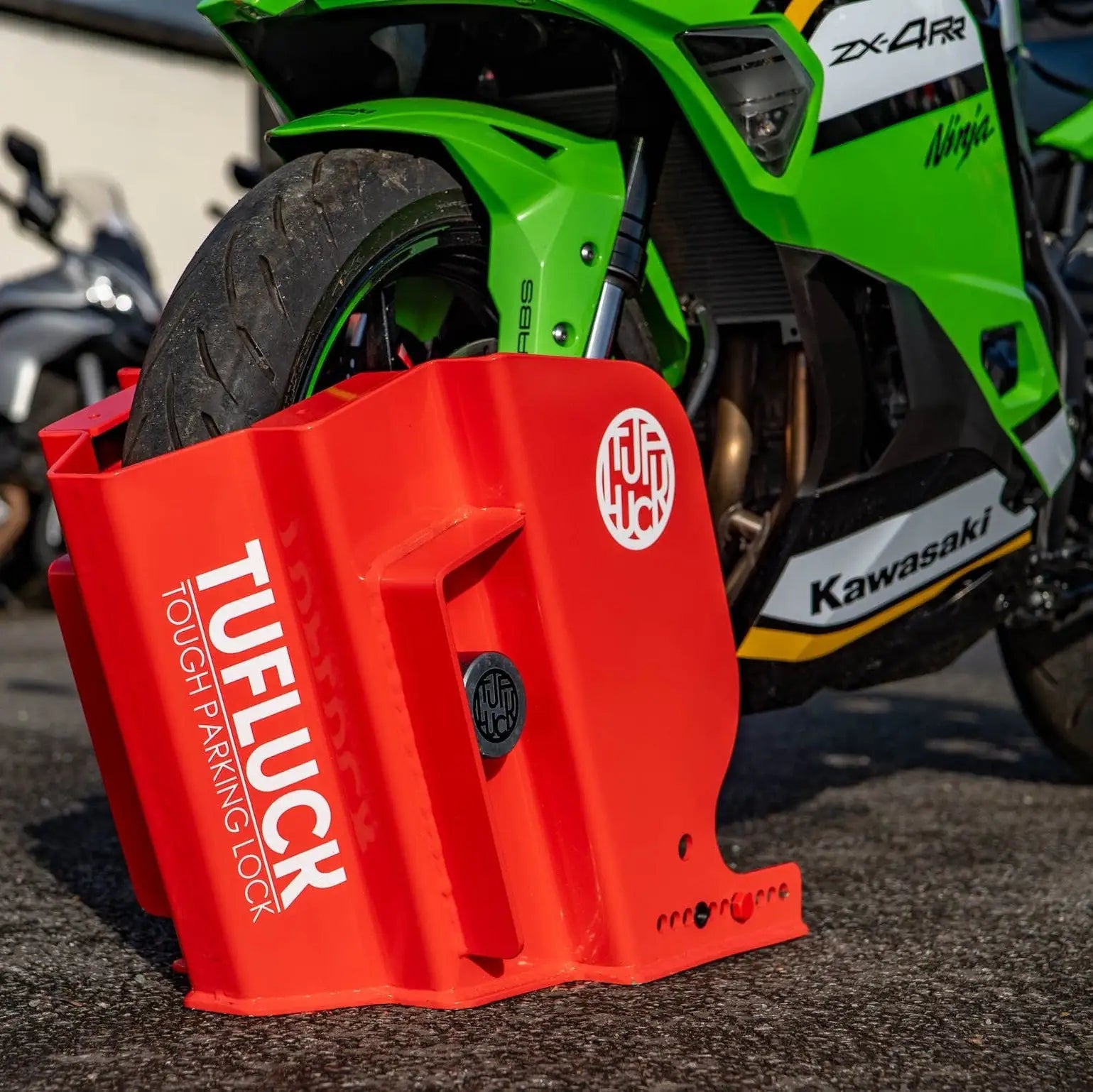
At home or in a garage, the physical layer is where you can make the biggest difference before a thief even gets started. TufLuck is a British-made motorcycle parking lock that combines a ground anchor and a wheel clamp in one unit. You roll the front wheel in and lock it, with no chain to thread and no shackle left exposed. It holds Sold Secure Diamond ratings both as a bolted ground anchor and as a free-standing wheel clamp, and because it's removable, it can come with you when you move house.
Pair something like that with a good tracker and an alarm, and you've covered prevention, deterrence and recovery, which is about as complete as bike security gets.
The short version
A motorcycle tracker is well worth having, especially on a bike you'd struggle to replace. Choose one with alerts and a backup battery, check what your insurer accepts before you buy, and factor in the running costs. Just remember that a tracker tells you where your bike went. Locking it down properly is what keeps it where you left it.